Space is empty. Like, really really empty. If you measured all the matter in in existence as one, it would take up 0.0000000000000000000042 percent of the universe. Travelling through most of it would feel solitary and dark… dark and nothingness unless you really squinted and saw tiny dots of distant stars and galaxies.
It would be pretty boring if games were set in a hyper-‘realistic’ space, so there’s always a bit of artistic license when it comes to where you’re flying around the map. From the scale of distances, to the colours, and breadth of phenomena you encounter, games always strive to make your visit interesting… even when the story demands you feel the solitude.
The theme of space has appeared across every genre of game, from role playing, to flight sim, and real time strategy. Let’s look at some interesting titles from history and how they use space as a theme, a setting, or a gameplay hook.
Elite: Dangerous
Leaning more towards the structure of our actual galaxy, Elite: Dangerous makes sure to keep the experience interesting by leaning into the contrast of the bleakness and beauty. Physics in this game tries to be as similar to real science as possible, with long distances between destinations, and little in the way of life outside a few locations.


The Elite series has a legacy spanning 40 years – and four games – pushed the envelope with what could be done to simulate the universe on a computer. The original Elite managed to squeeze 256 planets into the game, using procedural generation. Elite Dangerous, by contrast, has a galaxy filled with around 400 billion scientifically accurate procedurally generated star systems to visit, with 150,000 stars actually based on real astronomical research.
Basically, the game is huge but meant to feel how it would in the real world.
Homeworld
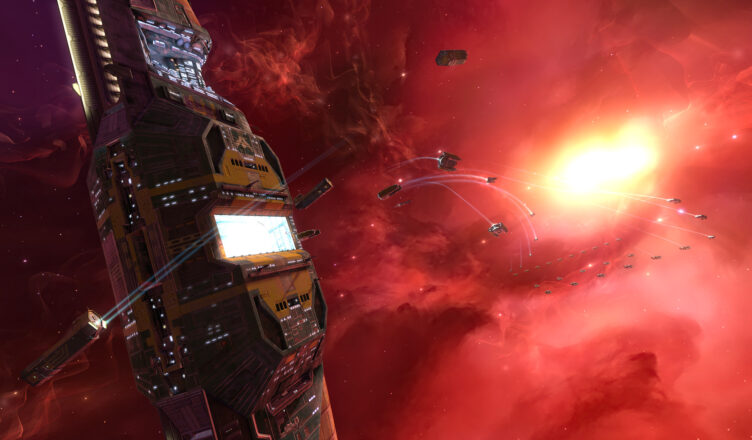
The game that first introduced efficient control of a 3D environment in a real time strategy game waaay back in 1999, Homeworld managed to make empty maps look beautiful, dramatic, and actually strategically exciting by cleverly spreading resources around landmarks, while using the height and depth of the map.


The multiplayer maps may not have been quite as varied, but throughout both games, the missions took you from planetary orbits to spaceship graveyards, nebulae, and radioactive asteroid fields. Every little detail makes you feel like you’re in command of a space navy. The UI looks like a tactical overlay, the ships all have their place in combat, and the sound design is just perfect, down to the radio interactions between the fighter wings, corvettes, and capital ships. There’s also deep lore to explore around the races, for those that seek it.
If that all sounds like your thing, then there’s good news… the prequel, Deserts of Kharak, is pretty darn good and affordable too. Especially when you snag it in a sale. And Homeworld 3 is just around the corner.
House Of The Dying Sun
The love child of Homeworld, Star Wars, and Warhammer 40K, House Of The Dying Sun is an intense, fast space combat game with a short and sweet story, tight vehicle movement, and a dark and ethereal backdrop. The game’s gothic story fits perfectly into the slightly blocky, muted art style, with a pragmatic UI that lets you pilot your fighter craft, give orders to wingmen, and command a small battlegroup of larger ships to assist. You can also swap to your team’s other fighters, letting you quickly take on your enemies from different angles.

With combat theatres that play like a small section of a Homeworld map, you have to make use of your speed, drift capabilities, and what little cover you can find to best your targets. Despite the missions boiling down to “kill everyone”, there’s so much atmosphere. Every detail, down to the sound of your pilot’s breathing changing when you do a hard spin, makes you feel like you’re there. And it’s another game that comes with a VR option.

I really wish House Of The Dying Sun received more recognition when it came out. It was created by one developer, as a labour of love, and it shows.
No Man’s Sky
There is a lot of space in No Man’s Sky.
18 quintillion planets, if you need a number. And every single one is generated in the software, using an endless combination of environments, creatures, and structures. The game plays very fast and loose with the structure of the solar systems, but it’s all in the name of making the game more engaging.

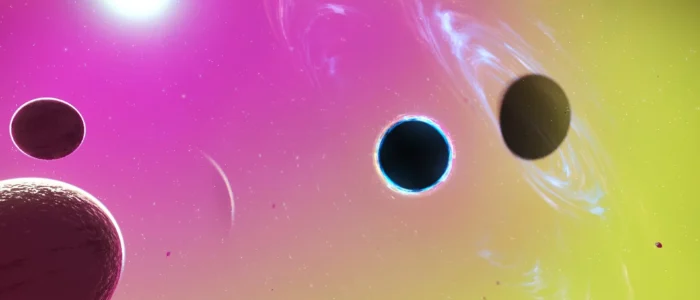

Despite over-promising and under-delivering when it launched, one thing that blew minds was the small detail that you could step onto a space station and watch the planet you just left from a view port, which is obviously a fairly common concept now. Hello Games also added a lot of new random finds while you explore space, such as this giant monster skull.

Eve Online
Since the environment has always been more of a backdrop for the spreadsheet [space] soap opera that is Eve Online, space is there to make everything feel HUGE. When players do finally gather for war, the battles are enormous, with thousands of nimble frigates, and cruisers, flying around gargantuan dreadnoughts and titans. In fact, when this happens there are so many players together, the server slows down events in the node hosting that sector using Time Dilation. This helps compensate for the lag caused by network traffic.
A meeting of factions like this is guaranteed to create an opportunity for some glorious screenshots.


Personally, I’ve always found the stories about Eve to be more enticing than the prospect of playing it. In fact, there are entire media channels devoted to telling the stories, and they get featured often on major gaming sites. From daring heists to corporate wars and political machinations that would make George RR Martin blush, space has never been so filled with intrigue and violence.
Adr1ft
Released in 2016, Adr1ft always felt like a bit of a sleeper. The concept is interesting: you’re an astronaut that wakes up next to a smashed up space station, and you need to figure out what happened and get home safely. The game leans heavily into the atmosphere (no pun intended) of stories such as The Martian or Gravity, with a harsh, unforgiving environment that you’re constantly battling. In fact, that’s your only opposition, floating from resource to resource, balancing your oxygen and fuel so you can continue to breathe and manoeuvre to your next objective.


To add to the rampant agoraphobia, the game also comes in VR flavour for that fully immersive feeling of nothing below you, while you’re drifting through the void hopelessly.

Since the game is mostly grounded in real near-future science, the environment truly is a void, with the stars blotted out by your only reference point… the pale blue dot spinning below you, Earth.
Stellaris
Unlike most of the games mentioned, Stellaris has to cope with showing massive galactic scales via strategic maps as well as individual systems, on top of all the resource management and building, so space needs to be interesting at every level. The large choice of planet and star types, as well as other astronomical objects to uncover, means that


Star Wars: Squadrons
Star Wars has always had its own way of presenting the grandeur of space. From the single biome planets, to the exciting, cluttered asteroid fields, everything is designed to make flying spaceships look exciting. Star Wars: Squadrons aims to capture the feel of space combat in the films, and largely succeeds. The campaign is short and sweet… almost an afterthought, if we’re honest, but fits in to the larger canon narrative with some good cameos, and plenty of interesting locales, like debris fields from half destroyed moons, to ship graveyards, and nebula clouds.


Where the game really shines, and makes use of the space backdrop, is the multiplayer. Your ship glides through the environment, and often finding cover, or sheltering near your massive capital ship, means life or death. Being Star Wars, the game plays fast and loose with zero gravity physics, borrowing a drifting mechanism from other games that has enough of a learning curve that after a few hours, you’ll feel like you’re Rogue Leader.
Fun above all else
So, maybe games don’t always have to play fast and loose with physics, but the single most important aim is for space to be a rich, colourful, and exciting place to explore. Since we’re all trapped on this rock, staring up at the sky in wonder, the mysteries of the universe will continue to be a wonder to us all, and video games are the perfect way to let our imaginations lead the way.
When space is used properly in a game, it can be scary, spiritual, and challenging. It’s the perfect vehicle to drive an engaging story, and fun gameplay mechanics. And that, ultimately, is what science fiction is about: a backdrop to explore the human condition and how it reacts to new forces.
The list above is not exhaustive, and the titles span several decades of gaming history. There are always new games coming out, tempted by the mysticism of a setting most of us will never reach. Games like NEBULOUS: Fleet Command, Homeworld 3, and the recently released Starfield.